
Whole body donation can create a lasting medical legacy, but many Texans hesitate because they are unsure whether registering permanently locks them into the decision. That uncertainty can become stressful when families worry about legal authority, changing wishes, funeral plans, or whether a program must accept the donation. In Texas, a properly executed anatomical gift is legally recognized and generally cannot be overturned by relatives after death. However, it is not irrevocable during your lifetime, and registration does not guarantee that a willed body program will accept your body when death occurs. The solution is to document your wishes correctly, understand the program’s eligibility rules, inform the people who may be present at your death, and maintain a practical backup plan. This guide explains how Texas law treats registration, revocation, family objections, final acceptance, transportation, cremation, and other important details.
The Direct Answer: Registration Creates a Legal Gift, Not an Unchangeable Contract
Registering with a legitimate whole body donation organization generally creates a legally recognized anatomical gift that is intended to take effect after death. Under the Texas Revised Uniform Anatomical Gift Act, a person may donate all or part of the body for transplantation, therapy, research, or education.
When the documents are completed in accordance with Texas law, the donor’s decision ordinarily takes priority over the preferences of surviving family members. A spouse, adult child, parent, or other relative generally does not gain authority to revoke a valid anatomical gift merely because that person disagrees with it after the donor dies.
That does not mean the registration operates like an irreversible lifetime contract.
Before death, a competent donor may amend or revoke the anatomical gift using legally recognized methods. The ability to withdraw is an important part of informed consent. A donor may change programs, revise instructions, select a different form of final disposition, or cancel the donation altogether.
The more accurate way to describe the arrangement is:
- It is legally effective when properly documented.
- It remains revocable by the donor during life.
- It generally becomes controlling at death.
- It does not force a program to accept the body.
- It does not eliminate the need for practical after-death coordination.
Texas law recognizes the donor’s decision, but acceptance still depends on the receiving organization’s policies and the condition of the body at the time of death.
What Texas Law Considers an Anatomical Gift
An anatomical gift is a donation of all or part of a human body that takes effect after the donor’s death. The gift may be made for several authorized purposes, including scientific research, anatomical education, medical training, transplantation, and therapy.
Whole body donation is sometimes described as:
- Willed body donation
- Non-transplant anatomical donation
- Medical body donation
- Cadaver donation
- Donation for anatomical study
- Donation for medical education and research
Although these terms are often used conversationally, the paperwork should clearly identify the intended gift and recipient. A general organ donor designation is not necessarily the same as authorization to donate body to science.
This distinction matters because the Texas organ, eye, and tissue donor registry does not automatically enroll a person in a whole-body program. Anyone interested in donating the entire body should register directly with the organization that is expected to receive the donation.
Organ Donation and Body Donation Are Separate Arrangements
Organ and tissue donation usually focuses on transplantation or therapeutic recovery. Whole-body programs generally use donated remains for education, surgical training, device development, forensic research, or other scientific purposes.
A person may sometimes register for both, but the options can conflict at the time of death. Certain willed body programs will not accept a donor after internal organs have been removed for transplantation. Other organizations may accept donors after limited tissue or cornea recovery.
Because policies differ, donors should not assume that registration in one system automatically satisfies the requirements of another.
A thoughtful plan should identify which priority matters most:
- Transplantable organ and tissue recovery
- Whole-body medical education
- Scientific or anatomical research
- Forensic decomposition research
- A backup funeral or cremation arrangement
The chosen programs should be asked how they coordinate with organ procurement organizations and whether prior tissue recovery affects eligibility.
How a Texas Resident Can Make a Valid Donation
Texas law allows an anatomical gift to be created through several legally recognized methods. Depending on the circumstances, a gift may be documented in a signed record, a will, a donor card, or another authorized form.
For planned whole body donation, the most reliable approach is to complete the receiving program’s official enrollment documents. These forms typically identify the donor, describe the intended gift, specify the authorized purpose, provide contact information, and include the required signatures or witness attestations.
Many Texas willed body programs require two adult witnesses for self-donation paperwork. Program requirements may be stricter than the minimum steps a person assumes are necessary, so completing only a general end-of-life document may not be enough for operational acceptance.
Why Program-Specific Forms Matter
A statement in a will can support the donor’s intentions, but it may not provide the practical information a receiving organization needs immediately after death.
Program-specific registration forms may cover:
- Authorization to receive and transport the body
- Permitted educational or research uses
- Medical and social history
- Identity verification
- Consent to preparation or preservation
- Cremation and disposition instructions
- Return or non-return of cremated remains
- Release of medical records
- Authorization to transfer specimens
- Contact information for the designated representative
- Geographic service limitations
- Financial responsibilities, if any
A will may not be reviewed until days after death. Whole body donation normally requires immediate notification, screening, and transportation. Therefore, relying only on a will can create delays that make the donation impossible.
Keep Copies Where They Can Be Found
After enrolling, donors should keep copies of the completed documents in accessible places rather than storing the only copy in a safe-deposit box.
Useful locations include:
- With the designated family contact
- In the donor’s medical file
- With an estate-planning attorney
- At an assisted-living or long-term-care facility
- Near advance directives and emergency documents
- In a clearly labeled home records folder
A donor card may also be carried in a wallet or purse. The purpose is not merely to prove legal intent. It gives healthcare providers, hospice workers, first responders, and family members the correct telephone number to call.
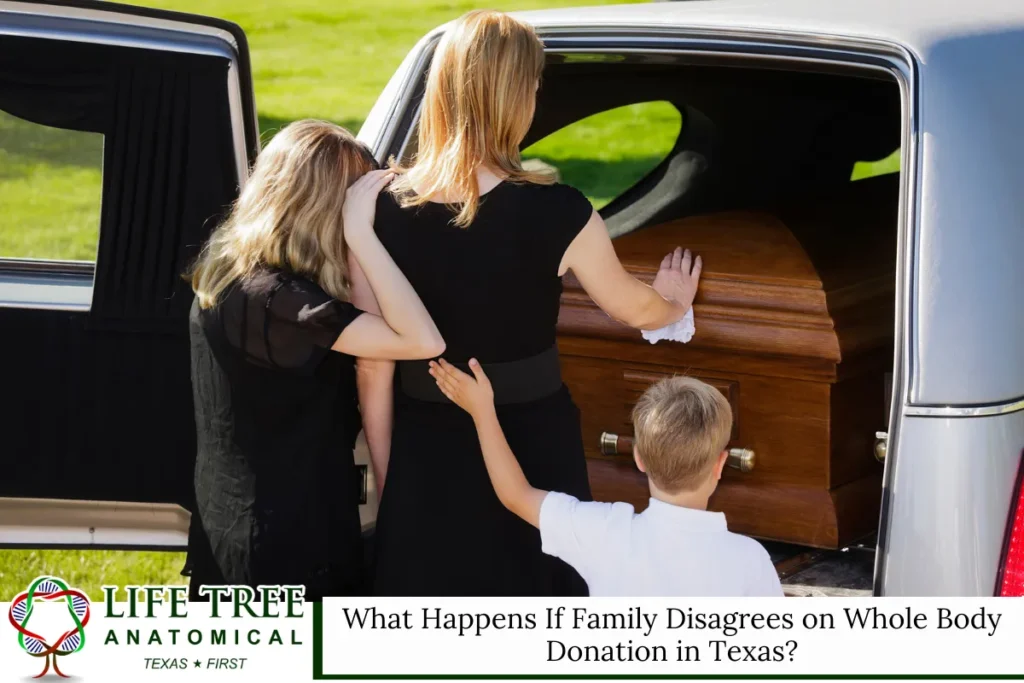
Can Family Members Override a Registered Donor?
When an adult donor has made a valid and unrevoked anatomical gift, Texas law generally prevents another person from making, amending, or revoking a conflicting gift after the donor’s death.
In practical terms, a family member’s disagreement does not automatically cancel the donor’s lawful choice.
However, legal priority and operational reality are not always identical. A donation can still fail when relatives do not know about it, refuse to notify the program, delay transportation, authorize embalming elsewhere, arrange an autopsy that was not otherwise required, or proceed with burial or cremation before the organization is contacted.
A program may also decline involvement when serious family conflict creates uncertainty about documents, identity, authorization, or custody.
For these reasons, donors should not treat family communication as optional merely because the documents are legally valid.
Family Awareness Prevents Avoidable Delays
A productive conversation should explain:
- Why the donor wants to make the gift
- Which organization holds the registration
- Who must be called immediately after death
- Whether organ donation remains a priority
- What memorial options will remain available
- Whether cremated remains will be returned
- How long the research period may last
- What backup plan should be followed if acceptance is denied
The goal is not to ask relatives for permission when the donor has full legal capacity. The goal is to make sure the donor’s decision can be carried out without confusion during an emotional and time-sensitive period.
Some programs strongly encourage the donor’s next of kin to witness the documents or formally acknowledge the plan, even where separate family approval is not legally required.
A Donor May Revoke or Change the Gift Before Death
A legally recognized donation does not prevent the donor from changing course.
Texas law permits an anatomical gift to be amended or revoked before death through authorized methods. The precise method may depend on how the original gift was made. For example, a gift contained in a will may be revoked through the procedures used to change or revoke a will or through another method recognized by the anatomical gift statute.
Programs commonly ask donors to submit a written cancellation notice. Written revocation creates a clear record and reduces the risk that outdated donor cards or copies of old forms will be relied upon.
A donor who cancels should:
- Notify the registered program in writing.
- Request written confirmation that the record was closed.
- Destroy old donor cards.
- Remove outdated forms from personal records.
- Inform family members and healthcare providers.
- Update advance directives and estate-planning documents.
- Document the preferred alternative disposition.
A donor changing from one organization to another should complete the cancellation process before distributing the new paperwork. Conflicting registrations can create uncertainty at the worst possible time.
Spoken Revocation Can Create Evidentiary Problems
Texas law recognizes certain forms of communication for amending or revoking a gift, including specific communications made during terminal illness or injury. Nevertheless, relying on an informal conversation is risky.
After death, relatives and institutions may disagree about:
- What the donor actually said
- Whether the donor had decision-making capacity
- Whether the statement was intended as a revocation
- Who heard the statement
- Whether the legal witness requirements were met
- Whether newer paperwork replaced earlier documents
A dated, signed written notice is usually the clearest approach. Anyone facing questions about capacity, competing documents, guardianship, or family disputes should obtain advice from a qualified Texas attorney.
Read What Happens If Family Disagrees on Whole Body Donation in Texas?
Why Registration Does Not Guarantee Final Acceptance
One of the most important distinctions in whole body donation is the difference between legal authorization and medical acceptance.
Registration documents the donor’s intent and gives the organization permission to evaluate the donation. It does not obligate that organization to receive the body under every possible circumstance.
Final screening normally happens after death because eligibility can depend on conditions that did not exist when the donor enrolled.
Common reasons for denial may include:
- Certain communicable or infectious diseases
- Severe trauma
- Advanced decomposition
- A substantial delay in notification
- Autopsy or extensive postmortem examination
- Removal of internal organs
- Extreme body size or weight limitations
- Generalized edema
- Recent major surgery
- Geographic or transportation limitations
- Lack of storage capacity
- Incomplete or inconsistent documentation
- Circumstances involving a medical examiner
- Conditions that prevent safe preservation or educational use
Each organization sets its own medical and operational standards. One program may decline a donor whom another organization can accept. Published eligibility information should therefore be treated as guidance rather than a final guarantee. Texas programs expressly warn that completing registration does not guarantee acceptance.
A Backup Plan Is Essential
Every donor should create an alternative plan for burial, cremation, or another lawful disposition.
The backup plan should identify:
- The person authorized to make arrangements
- A preferred funeral home or cremation provider
- How costs will be paid
- Whether funds or insurance are available
- Religious or cultural preferences
- Memorial service instructions
- The location of important documents
Families should understand that denial is not a rejection of the donor’s generosity. It is often the result of safety, timing, capacity, transportation, or educational requirements.
What Happens at the Time of Death
Whole body donation is highly time-sensitive. The correct sequence depends on where and how the death occurs, but the donor must first be legally pronounced dead by an authorized professional.
After pronouncement, the family, hospice representative, hospital, nursing facility, or other responsible person should contact the registered program immediately.
The organization will ordinarily conduct a telephone screening that may address:
- Time and location of death
- Cause and manner of death
- Infectious disease history
- Recent surgeries or injuries
- Organ or tissue recovery
- Autopsy requirements
- Height and weight
- Condition of the body
- Identity and authorization documents
- Transportation distance
- Availability of the program
The family should not authorize embalming, cremation, or transport through an unrelated provider until the donation organization gives instructions.
Medical Examiner Cases May Affect the Process
Certain deaths must be reported to a justice of the peace, medical examiner, or other legal authority. Examples may include unexpected, unattended, violent, suspicious, accidental, or otherwise reportable deaths.
The donor’s registration does not remove the authority of officials to investigate a death or order an examination when required by law.
If an autopsy is performed, the body may become unsuitable for some anatomical education programs. Other research organizations may still be able to accept it. Families should notify both the relevant public authority and the donation organization as soon as possible rather than assuming the donation has automatically failed.
What a Willed Body Program May Do With the Donation
Programs use donated bodies in different ways. Medical-school programs often emphasize anatomy education for students preparing for careers in medicine, dentistry, nursing, physical therapy, physician-assistant practice, and other health professions.
Donors may also support:
- Surgical procedure training
- Continuing education for physicians
- Development of medical devices
- Orthopedic technique research
- Emergency procedure training
- Imaging research
- Biomechanical testing
- Anatomical variation studies
- Forensic science
- Clinical skills development
The donor should review the consent language carefully. A form may authorize use by the enrolling institution, transfer to other qualified facilities, preparation of individual anatomical specimens, long-term retention of certain parts, or use in multiple educational projects.
Registration should be based on informed consent, not assumptions.
Questions to Ask Before Enrolling
A reputable organization should be able to answer clear questions about its policies. Consider asking:
- What educational and research uses are permitted?
- May the body or anatomical specimens be transferred?
- Are recipients limited to accredited or licensed institutions?
- Can the donor restrict specific uses?
- Are photographs or medical images created?
- How is donor identity protected?
- How long may the body remain in the program?
- Will all recoverable remains be cremated?
- Are cremated remains returned to the family?
- Are remains commingled?
- What expenses are covered?
- Are there transportation mileage limits?
- What conditions may cause denial?
- Is the family notified of final disposition?
- What happens if the organization closes or cannot accept the donor?
These questions help distinguish a carefully considered gift from a registration made without sufficient information.
Costs, Transportation, and Cremated Remains Vary by Program
Many people assume donating body to science always eliminates funeral expenses. Sometimes it significantly reduces them, but there is no universal cost policy.
A program may cover:
- Initial transportation
- Preparation or preservation
- Approved medical or educational use
- Cremation
- Return of cremated remains
Other programs may charge or leave the family responsible for:
- Transportation beyond a defined radius
- Funeral home involvement
- Embalming before long-distance transport
- Copies of death certificates
- Memorial services
- Return shipping
- Private cremation
- Alternative disposition after denial
Texas programs vary considerably. Some retain donors for several months, while others may keep them for two years or longer. Some return ashes automatically; others scatter cremated remains unless the donor requested return in advance. Certain forensic programs do not return remains because of the nature of decomposition research.
The donor should request written answers instead of relying on a general promise that the process is “free.”
Does a Will Make the Donation More Legally Secure?
A will can reinforce the donor’s intent, but it should not be the only place where the decision appears.
Whole body donation requires immediate action. Wills are often located, reviewed, or submitted to probate after the useful notification window has passed.
A stronger planning approach combines:
- The program’s signed donor form
- Any required witness signatures
- A donor identification card
- Written instructions for the designated representative
- Consistent language in estate-planning documents
- Copies provided to close family members
- Current program contact information
- A backup disposition plan
A separate Texas appointment for control of remains may also help identify the person expected to handle final arrangements. However, that document should be coordinated with the anatomical gift rather than written in a way that creates conflicting instructions.
What Happens When the Donor Lacks Capacity?
A person generally needs sufficient legal and mental capacity to make an informed anatomical gift.
Questions may arise when a prospective donor has dementia, a neurological condition, a serious psychiatric illness, intellectual disability, guardianship, medication-related impairment, or another condition affecting decision-making.
A diagnosis alone does not always establish incapacity. Capacity is often specific to the decision and the time it is made.
When capacity is uncertain, the safest course is to involve appropriate medical and legal professionals before completing the documents. Programs may decline enrollment when they cannot confidently verify voluntary and informed consent.
After death, Texas law identifies categories of people who may be authorized to make an anatomical gift when the decedent did not make one personally. The applicable priority can include an authorized agent, spouse, adult children, parents, adult siblings, guardian, or another person authorized by statute, depending on the circumstances.
An after-death donation should not be confused with a self-directed registration completed during life.
Legal Authority Does Not Remove Ethical Responsibility
Texas law provides the foundation for anatomical gifts, but donors should also evaluate how an organization handles consent, dignity, traceability, transfers, records, and final disposition.
Before registering, review the full agreement rather than relying only on advertising language. Pay special attention to provisions involving:
- Transfer of the body or body parts
- Use by third-party researchers
- Commercial entities
- Medical-device testing
- Permanent specimen retention
- Separation of anatomical parts
- Interstate transportation
- Photography or imaging
- Confidentiality
- Cremation
- Commingling
- Return of remains
A donor who is uncomfortable with any authorized use should ask whether restrictions are permitted. If the program cannot honor those restrictions, another option may be more appropriate.
The most meaningful anatomical gift is one based on clear, voluntary, and fully informed consent.
Steps That Make a Texas Donation Plan More Reliable
Registration is only one part of a workable plan. The following measures make it more likely that the donor’s wishes will be recognized and implemented:
- Choose a program that clearly explains its uses and policies.
- Complete every required field and signature.
- Use qualified witnesses when required.
- Return the original documents if the program requests them.
- Obtain written confirmation of enrollment.
- Carry the donor card.
- Give copies to the people most likely to be present at death.
- Inform physicians, hospice providers, and care facilities.
- Review the program’s acceptance criteria.
- Coordinate organ and tissue donation preferences.
- Update contact information after moving.
- Reconfirm the registration periodically.
- Maintain a backup cremation or burial plan.
- Provide instructions for memorial services.
- Explain the decision to family before a crisis occurs.
These steps do not guarantee acceptance, but they reduce preventable delays and misunderstandings.
The Practical Meaning of a Legally Valid Registration
For most Texans, registering through the proper documents means the anatomical gift will be legally recognized when death occurs. The donor’s valid decision generally takes priority over a later objection from family members.
Still, “legally binding” should not be misunderstood.
The registration does not trap the donor in the decision during life. It does not override required death investigations. It does not guarantee that medical screening will be passed. It does not force a particular organization to accept a body that falls outside its criteria. It also does not automatically resolve transportation, timing, communication, or family coordination.
A sound whole body donation plan combines four elements:
- Legally sufficient consent
- A suitable receiving organization
- Immediate after-death notification
- A realistic alternative disposition plan
When those elements are addressed together, donors can make the decision with greater confidence and families can respond with far less uncertainty.
A Documented Gift Works Best When Everyone Knows the Plan
The answer to whether registration is legally binding in Texas is qualified but reassuring: a properly made anatomical gift is legally effective and generally controlling after death, yet the donor retains the right to revoke or amend it while alive.
The receiving program must still determine whether the body can be accepted. That decision may depend on medical condition, timing, transportation, organ recovery, autopsy status, safety standards, storage capacity, and the organization’s current needs.
Texans who wish to donate body to science should complete the correct forms, review all consent provisions, speak with family members, keep contact information accessible, and prepare an alternate arrangement. Legal documentation provides authority. Communication and preparation make that authority workable.
Texas Whole Body Donation – Life Tree Anatomical
At Life Tree Anatomical, we help Texans make informed, compassionate decisions about whole body donation. We explain registration, eligibility, transportation, required documents, final acceptance, and what families should expect when death occurs. Our team serves the entire state of Texas and works to make the process clear during a time that can otherwise feel overwhelming. When you choose to donate your body to science, your gift may support medical education, professional training, research, and future healthcare advances. We encourage donors to plan early, communicate their wishes, and maintain accurate records. Call Life Tree Anatomical at (512) 402-8533 to discuss your options, or fill out our contact form to begin the registration process. We are ready to answer your questions and help you create a thoughtful whole body donation plan.
Frequently Asked Questions
Can a donor request that the body be used only within Texas?
A donor may ask whether use can be geographically restricted, but the answer depends on the consent agreement and the receiving organization’s policies. Some programs use donors exclusively at one Texas institution, while others may transfer the body or anatomical specimens to qualified educational, research, or medical-training facilities elsewhere. A donor should not assume that statewide service means the remains will stay within Texas. Review any provision authorizing transfer, distribution, collaboration, or shipment. Ask whether a geographic restriction can be added in writing and whether the program will accept a registration containing that condition. Do not rely on an oral assurance that is inconsistent with the signed consent form.
Can a family hold a traditional memorial service without the body present?
Yes. Families may hold a memorial service, celebration of life, religious ceremony, military tribute, or other gathering without the donor’s physical remains being present. Many families schedule the service soon after death while the body is in the care of the donation organization. Others wait until cremated remains are returned. The donation program usually does not arrange or pay for the memorial event, obituary, venue, clergy, flowers, reception, or related expenses. Donors should discuss ceremonial preferences in advance because research timelines can vary. A memorial service without the body can still include photographs, personal belongings, readings, music, eulogies, and cultural or spiritual traditions important to the family.
Will whole body donation delay issuance of the death certificate?
The donation itself does not ordinarily prevent a death certificate from being issued, but processing time depends on the circumstances of the death and the responsible local authorities. A physician, justice of the peace, or medical examiner may need to certify the cause and manner of death. Investigations, toxicology testing, or incomplete medical information can delay final certification independently of the donation. Families should ask who will file the certificate and how certified copies can be ordered. Donation organizations generally focus on receiving and transporting the body rather than managing every administrative duty associated with the estate. Death certificates may be needed for insurance, Social Security, banking, property transfers, and probate matters.
Can veterans receive military honors after donating their bodies?
Eligible veterans may still receive military funeral honors even when the body has been donated for medical education or research. The family can generally request ceremonial folding and presentation of the United States flag and the playing of “Taps” at a memorial service. Eligibility and available honors depend on military service records and applicable federal requirements. Families commonly use the veteran’s discharge document, such as a DD Form 214, to establish eligibility. Because the body may not be present, the service can be organized as a memorial rather than a traditional casket funeral. Veterans and families should contact the appropriate military honors coordinator or funeral provider in advance to discuss arrangements.
What should happen to an existing prepaid funeral contract?
A donor should review any prepaid funeral, burial, cemetery, or cremation contract before enrolling in a willed body program. The contract may remain useful as a backup if the donation is declined, but some services may no longer match the donor’s primary plan. Cancellation, transfer, refund, and trust-funding rules depend on the agreement and applicable law. Do not automatically cancel a prepaid arrangement solely because registration has been completed; final acceptance cannot be guaranteed. Contact the provider and ask which benefits remain available for memorial services, death certificates, alternative transportation, cremation, or burial. Keep written records showing whether the contract was retained, revised, transferred, or canceled.
Disclaimer: This article provides general information about Texas anatomical gifts and is not legal advice. Laws, forms, and program policies may change. Consult a Texas attorney and the selected donation organization regarding individual circumstances.
Read Is Whole Body Donation Ever Rejected at the Time of Death?