Whole body donation in Texas offers an incredible way for people to make a lasting impact on medical education, research, and the future of healthcare. But many families worry about what happens after donation—specifically, “Will my family receive my ashes after donation?” This question can bring up concern, confusion, and even some anxiety. People want to do the right thing by helping society, but are unsure if their own wishes and their family’s needs will be respected. The good news is, Texas has clear rules and compassionate procedures about how the process works, especially when it comes to returning cremated remains to loved ones. This article breaks down everything you need to know about Texas whole body donation, from registering as a donor to what your family can expect after your gift is complete, in a way that’s simple and easy to understand.
What Is Whole Body Donation and How Does It Work in Texas?
Whole body donation means giving your body, after death, to be used for medical research, anatomical instruction, surgical training, and education programs at medical schools or research institutions. In Texas, this is most often done through a Body Donation Program at a university medical center or through a licensed donation organization for research and education.
When you choose to donate your body to science, it becomes a generous anatomical gift that helps train medical students, healthcare professionals, and biomedical scientists. Donated bodies (sometimes called whole-body donors) allow these individuals to gain in-depth knowledge of human anatomy, practice surgical techniques, study diseases, improve medical devices, and develop new treatments. Medical research donations are sometimes used in forensic science and in non-transplant anatomical donation, too.
In Texas, the process is overseen by the Texas State Anatomical Board, and each Whole Body Donation Program follows state law, ethical standards, and strict consent protocols. Institutions like the University of Texas Southwestern (UT Southwestern), UT Health San Antonio, Texas A&M University, Texas Tech El Paso, and UTMB Galveston all have Willed Body Programs. There are also national private organizations, such as Science Care and LifeTree Anatomical, that work with local communities.
Pre-Registration, Consent, and Legal Next of Kin: Getting Started with Body Donation
Pre-Registration and Donor Paperwork
To donate your body to science, it’s best to pre-register. This is done by filling out a Bequest Form, a donor consent form, a Body Bequeathal Agreement, and sometimes a Personal Data Sheet. The donation program coordinator will guide you through these registration documents and send you an information packet (sometimes called Will Form Information Packet or donation packet).
Some programs issue a donor card that you can carry in your wallet. It’s wise to tell your next of kin (the closest legal relative), executor, or other authorized representative about your wishes and share copies of the donor forms.
Who Can Authorize Donation?
Texas law requires either the donor’s prior informed consent (signed forms), or—if not pre-registered—the legal next of kin’s authorization at the time of death. The Donation Form, Third-Party Authorization form, and other consent paperwork must be properly completed. If the donor has died without pre-registration, family authorization is usually needed.
Donor prequalification helps determine if you are a good candidate based on medical history, acceptance protocol, and eligibility criteria.
Acceptance Protocol and Eligibility: Who Can Donate?
Medical and Legal Requirements
Not every donated body can be accepted. Most Willed Body Donation Programs have eligibility criteria, including medical record review and sometimes serology testing.
Typical exclusions include:
- Autopsy requirements or an autopsied body (an autopsy is generally not permitted before acceptance)
- Infectious diseases (HIV/AIDS, hepatitis B/C, tuberculosis, COVID-19)
- Advanced natural decomposition
- Recent major surgery or extensive trauma injuries
- Cancer types affecting the entire body
- Extreme obesity (BMI/weight limits)
- Organ donation limitations (most accept only cornea/eye donations along with body donation)
Other Limitations and Alternatives
If donation to science is not possible, the family must make alternate arrangements (funeral services, direct cremation, or natural decomposition as permitted). Organ and tissue donors (for transplant) are handled separately and generally can’t also do whole body donation, except for corneal donations in some programs.
The Body Donation Process Step-by-Step
What Happens When Someone Passes Away
Upon the donor’s death, the funeral home, hospital, nursing home, or palliative care team notifies the donation organization or university Willed Body Program. The program then coordinates transport services and arranges for the removal and transportation of the body to their research facility or Medical Institution.
Costs associated with transporting the body (within a set mileage radius; out-of-area fees may apply) and the required free cremation are usually covered by the program. The family is not responsible for costs such as transporting the body or cremation within a certain area. However, items such as obituary publications, additional certified death certificates, or extended mileage transport may not be covered.
The Willed Body Program files the death certificate with Texas Vital Records and often provides certified copies for legal and personal use.
Study, Education, and Research
Upon arrival, the donor’s gift is respectfully used for medical education (training medical students and professionals and teaching human anatomy), research (medical and forensic research), and surgical training. The study period varies by program from a few weeks (private industry) to 6–24+ months (university programs). During this time, the identity of the donor remains confidential and donor information is kept secure.
When the study is complete, the cremation process (cremating the body) is performed by the university’s licensed crematory or their trusted funeral homes/crematories. All final disposition and handling of remains follow ethical, legal, and industry regulations.
Cremation After Body Donation: How It Works
Is Cremation Included?
Yes! As part of the body donation program, free cremation is always included. This saves families significant funeral costs. The cremation service is generally provided at no cost as part of most Willed Body Programs and accredited donation organizations.
Fire cremation (not alkaline hydrolysis or green burial) is standard. Embalming is generally not performed before acceptance.
Memorial Services, Tribute Ceremonies, and Commemoration
Many medical schools and research programs host annual or semiannual memorial services or remembrance ceremonies, or offer opportunities for personal tributes. These services may be open to family and friends to honor the generous donor.
Return of Cremated Remains: Options for Texas Families
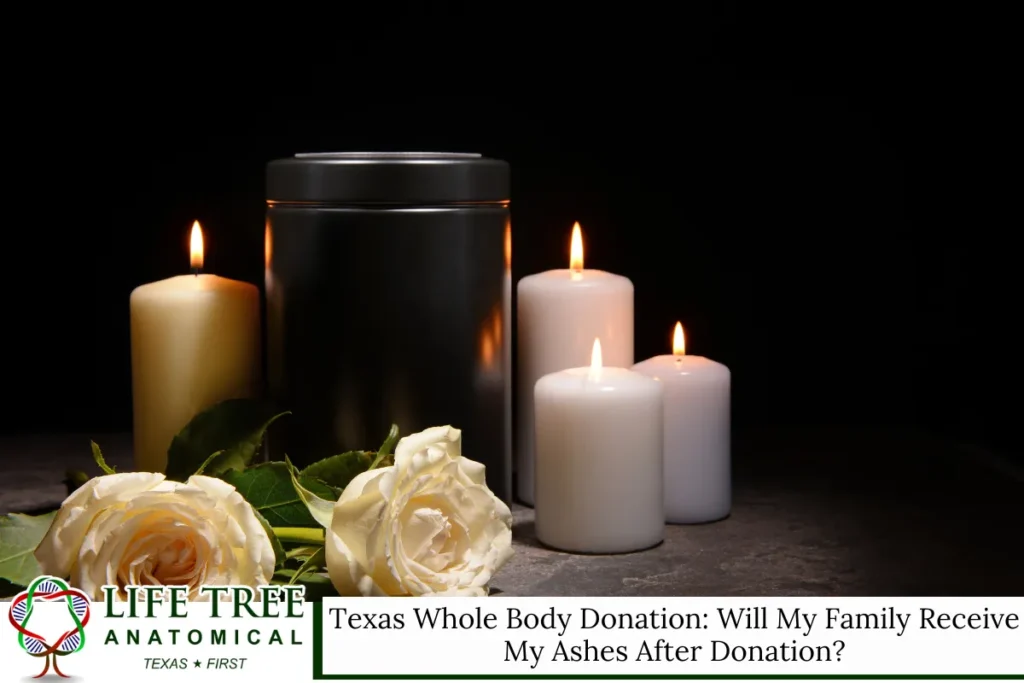
Will My Family Receive My Ashes After Donation?
Yes, in almost all Texas programs, the family may request return of ashes (cremated remains, also called cremains). This request should be clearly documented in the original donation agreement or consent form, specifying the disposition of the ashes.
- Does the Family Automatically Receive Ashes?
- No, it is not automatic. The next of kin (or legally authorized representative) must indicate in writing, using the Donation Form or a specific cremains release form, that ashes should be returned. There are time limitations—most programs require written instructions within a short time after death or at pre-registration.
- Who Decides What Happens to the Ashes?
- The donor’s wishes, as expressed in the authorization or consent forms, are honored whenever possible. If unclear, the next of kin makes the decision. This applies to whether the ashes are mailed back or handled in another way.
Other Disposition Choices: Scattering, Burial, Communal Interment
Families have several options for final disposition, and can indicate these on the donation forms:
- Request Return of the Ashes: Ashes can be returned to the family, usually by registered mail (USPS Priority Mail Express, which is legally required for shipping cremated remains) or local pick-up if nearby.
- Communal Interment or Scattering: If the family doesn’t wish the ashes to be returned, most Texas schools provide dignified communal interment in a memorial garden, cemetery plot, or scatter the ashes on university property, as outlined in program materials.
- Default Method: If the family does not request the ashes, communal interment or scattering is usually the default disposition.
- Urn or Keepsake Urn: Families may transfer the ashes to a personal urn after receipt if they wish.
Read Texas Whole Body Donation: How Long Does It Take to Return the Cremated Remains?
How Long Does It Take to Get the Ashes Back After Donation?
The time frame varies depending on the program and the length of study:
- University Programs: 6–24+ months (sometimes up to 3 years), as donated bodies may be used for extensive medical study.
- Private Organizations: A few weeks to a few months (such as Science Care or LifeTree Anatomical).
- Time Frame Example: If a university says “up to 2 years,” this means the ashes will likely be returned between one and two years after death.
The program will notify the family when the ashes are ready, and work with them to coordinate return shipping or pick-up.
Costs and Financial Considerations
What Costs Are Covered?
- Covered: Within the mileage radius, transportation/pickup, cremation, legal paperwork, death certificate filing, and return shipping of ashes (if requested).
- Not Covered: Obituaries, extra certified death certificates, funeral home expenses outside the program, out-of-area transportation, special ceremonies, and sometimes final burial fees if families want to scatter ashes in another cemetery.
No financial compensation is paid to the family or donor for anatomical donation, and donating your body to science is not tax-deductible. Memorial contributions (for example, to a medical school) may be made in honor of the donor, but these are separate from the body donation process.
Special Considerations: Out-of-State Families & Shipping Cremains
If the family lives in another state, ashes can still be mailed. Laws require cremated remains to be shipped using USPS Priority Mail Express with tracking. Some families choose to pick up ashes locally or have them shipped to a funeral home closer to home.
The crematory or university will help with urn selection (or use a standard container), required documentation, and all shipping details. The process is secure, with all legal forms and a clear chain of custody.
Differences Between University Programs and Private Donation Organizations
- University Programs: Bodies are used for education and research at medical schools, for training medical students, for teaching health professions, and for surgical techniques; the study period is longer, and communal interments often take place at campus memorial gardens or cemeteries.
- Private Organizations (Science Care, LifeTree Anatomical, MERI/Genesis): Bodies may be used in industry settings, medical device testing, or professional workshops. The time frame is shorter; ashes are typically returned to the family more quickly. These groups usually maintain AATB accreditation.
- Accreditation Program: Ensure your chosen program is accredited and complies with legal and ethical guidelines.
Religious and Personal Wishes
Texas programs honor religious considerations and personal wishes about final disposition. Families should discuss their concerns with the donor program coordinator in advance and write special instructions into the registration forms so that all wishes are known and respected.
Documentation and Security
All donation procedures are documented with clear instructions about handling, cremation services, and return or final disposition of cremated remains. Donor forms, membership agreements, and medical history are securely maintained. The family is usually not informed about the specific use of the donor’s body, as these details are confidential.
Denied Donations and Alternatives
If the body is not accepted for donation, the family will be notified right away, so funeral or direct cremation arrangements can be made. Most programs provide information about alternative plans and offer referrals to funeral homes or mortuary services.
Texas Whole Body Donation – Life Tree Anatomical
Looking for a compassionate, reputable partner for whole body donation in Texas? Life Tree Anatomical makes it simple to give the ultimate gift for medical research and education—while respecting your family’s wishes. Families often ask, “Will my ashes be returned after donation?” With Life Tree Anatomical, the answer is YES. We ensure clear communication, ethical procedures, and timely return of cremated remains, keeping your legacy and loved ones at the heart of everything we do. Whether you need quick answers about eligibility or want to start the registration process, our caring staff will guide you every step of the way.
Call us today at (512) 402-8533 to schedule a consultation and learn more about whole body donation. We proudly serve Texas families.
Frequently Asked Questions
1. Can I donate my body to science if I am also an organ donor?
Yes, but with restrictions. In Texas, most body donation programs can accept donors who have only donated their eyes (corneas), since organ and tissue donation for transplant can conflict with medical study needs. If you are registered as a full organ donor (heart, lungs, kidneys, etc.), you generally cannot also be a whole-body donor except for the eyes. It’s important to notify the body donation program of your donor status and ask for guidance.
2. What paperwork needs to be completed for body donation in Texas?
You will need to fill out a donor consent form (which may be called a Bequest Form, Donation Form, or Body Bequeathal Agreement), provide medical history, and sometimes additional forms such as a Personal Data Sheet or Third-Party Authorization Form. The donation program will give you a registration document packet. Make sure your next of kin knows about your wishes and the location of these forms. If you pre-register, you may receive a donor card to carry.
3. How is donor information protected?
Texas body donation programs are required to safeguard donor information, using secure files and privacy policies in accordance with Texas law and state regulations. Personal and medical data is kept confidential and only used for necessary communication with family and legal processing. The details of how a particular donor’s body was used are typically not shared with the family, out of respect for privacy.
4. What happens if the family does not request the ashes?
If no one requests the ashes, the default method of final disposition in Texas is respectful communal interment or scattering of the ashes in a university memorial garden or a cemetery. The family can always clarify their wishes in writing, but if no instructions are received, the university will arrange for the remains to be handled in a dignified, collective manner, and records will be kept permanently.
5. What if the donor changes their mind before death?
A donor may revoke or withdraw consent at any time before death. This is usually done by notifying the donation program in writing. The program will then update their files, cancel the registration, and confirm revocation with the donor and next of kin. Make sure to destroy donor cards or registration materials if you withdraw your decision, to avoid confusion after your passing.
Giving the Greatest Gift: The Impact of Texas Whole Body Donation
Choosing to donate your body to science in Texas is a powerful act of generosity and hope. The process is well-documented, transparent, and designed to honor both donor and family wishes at every step—including the careful, respectful return of ashes if requested. By understanding your options, completing the consent paperwork, and clearly communicating your wishes, you empower your loved ones to honor your legacy while advancing medicine for generations to come.
For more detailed guidance, reach out to local university medical schools or trusted donation organizations. They will provide up-to-date information, eligibility guidance, and compassionate support throughout your whole body donation journey.
Read Texas Donate Body to Science: Tattooed Donor Eligibility and State Regulations